
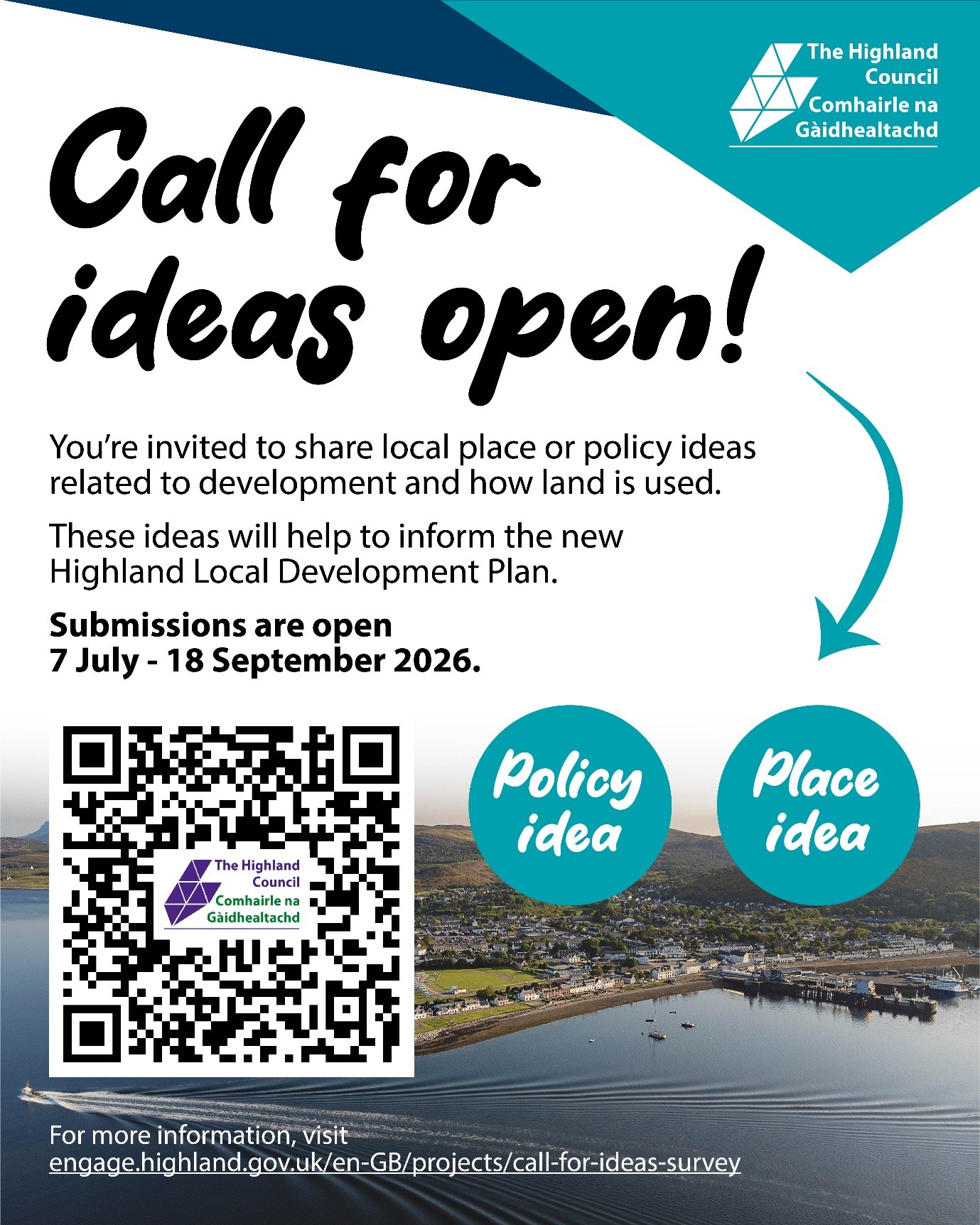
Share your ideas and help shape the places, spaces and communities of tomorrow.
The Highland Council is inviting people to share their ideas relating to the development or long-term land use in Highland. These ideas will be used to help shape policies, development standards and placemaking priorities in the next Highland Local Development Plan (HLDP).
Take part here
HLDP will replace the current Highland Wide Local Development Plan (HwLDP), Inner Moray Firth Local Development Plan 2 (IMFLDP2), Caithness and Sutherland Local Development Plan (CaSPlan) and West Highland and Islands Local Development Plan (WestPlan). When adopted HLDP will outline land use and where development should and should not happen within Highland, providing a long-term vision and 10-year spatial strategy for Highland.
Chair of the Council’s Economy and Infrastructure Committee, Councillor Ken Gowans said: “This Call for Ideas consultation is an opportunity to share what matters most to you, from how our towns and villages grow, to how we protect our landscapes, improve local facilities and respond to climate change.
“Your ideas will play an important role in shaping the next Highland Local Development Plan, guiding how land is used and how our communities develop over the years ahead. Whether it’s suggesting new spaces, improving connections for walking, cycling and wheeling, or influencing the policies that guide development, every idea has value.
“I would strongly encourage anyone with an interest in their local area to take part. By working together, we can create a plan that reflects the needs, ambitions and unique character of Highland.”
A short Call for Ideas survey is available on the Council’s new engagement platform engage.highland.gov.uk
This survey is open to everyone wanting to help shape the future of Highland.
The survey will close on 18 September 2026.
About the Engage Highland platform
The easy-to-use platform allows anyone to quickly see what projects and proposals are open for consultation and engagement. People can choose to register, or take part in consultations without registering.
For registered users, there are interactive mapping and voting capabilities as well as a mechanism for the vital ‘feedback’ loop, to find out what has been agreed and why. Users can also set up alerts, so they receive automatic notifications when any consultations are launched in a specific geographic area or on a topic, they are particularly interested in.