
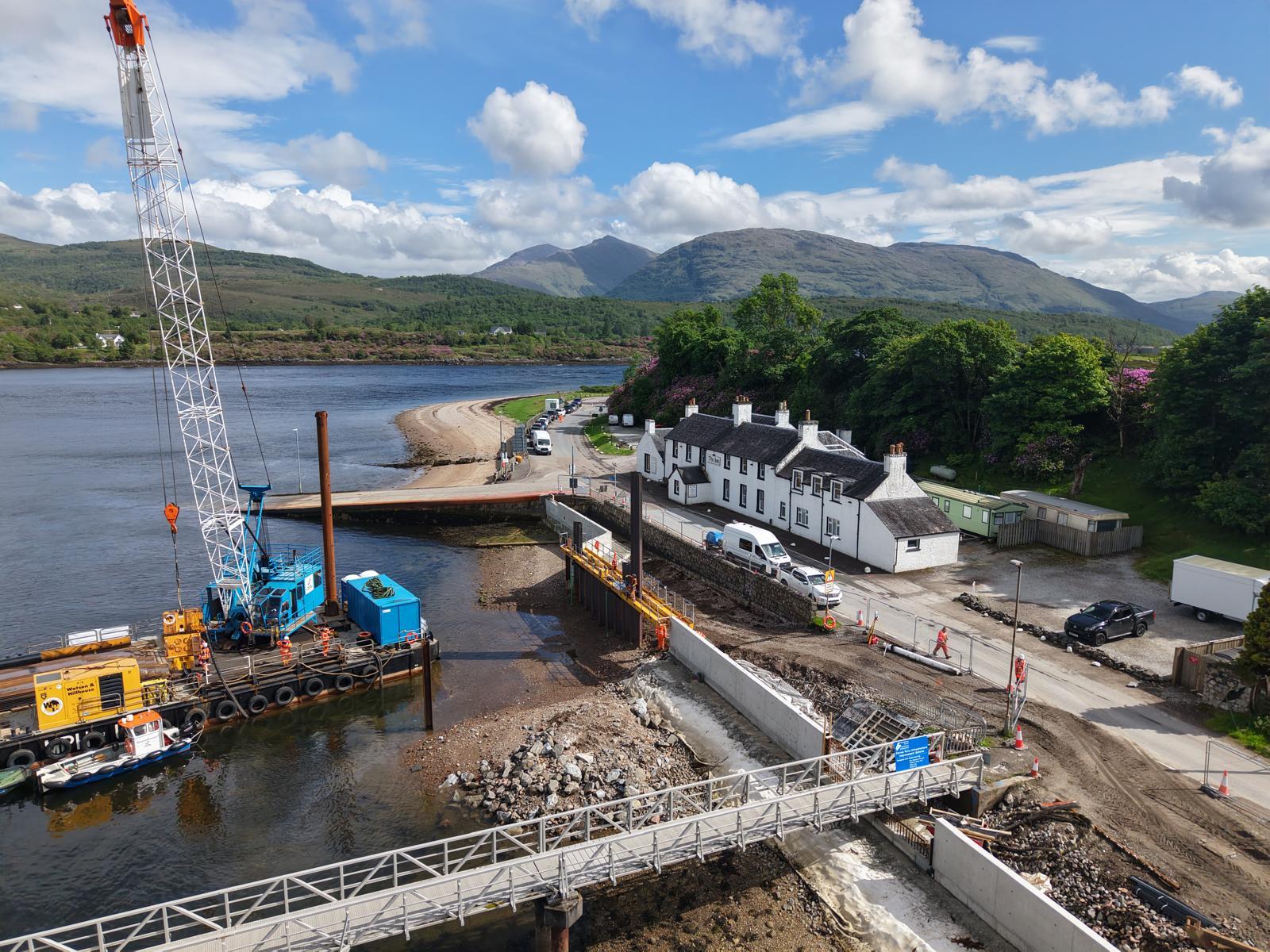
Significant progress has been made over recent months on the Corran Ferry Infrastructure Improvement Scheme (CFIIS), with works advancing at both Nether Lochaber and Ardgour.
Backed by £30 million through the Inverness and Highland City-Region Deal, including £20 million from the UK Government and £10 million from The Highland Council, the project will deliver critical landside infrastructure upgrades at one of Scotland’s busiest single-vessel ferry crossings. Construction work is scheduled over an 18-month period, with completion anticipated in summer 2027.
Five months into construction, the project has reached a key stage, with a strong focus on major marine works which include new slipways, an overnight berth, and a breakwater.
Economy and Infrastructure Committee Chair, Cllr Ken Gowans said: “We are pleased with the strong progress made during the first phase of construction. As the project moves further into its marine phase, activity has naturally increased. We recognise that this brings greater visibility on site and may cause some disruption for local communities.
“We would like to thank residents and road users for their continued patience and understanding as we deliver these important improvements.
“The principal contractor, Charles Brand Group Ltd, continues to work closely with the Council’s Infrastructure Project Design Unit (PDU), and we remain committed to keeping the community informed. Monthly Community Liaison Meetings are held at Ardgour Memorial Hall, providing an opportunity for residents to hear updates and ask questions.”
Nether Lochaber:
At Nether Lochaber, construction continues to move forward across several important areas:
- Installation of the alignment structure is progressing well, with six foundation piles now in place.
- Earthworks for new parking and marshalling areas are well advanced.
- The new A82 junction is partially complete and is currently operating without traffic signals, helping to maintain traffic flow.
- Rock armour is being installed along the foreshore to protect against erosion.
- Dredging works have recently resumed and will continue over the coming months.
Earlier in the project, essential site preparation included woodland clearance carried out ahead of bird breeding season, with measures in place to protect wildlife. Invasive species, including Japanese knotweed, were also removed to support long-term environmental management.
Ardgour:
Work at Ardgour has also progressed significantly, particularly on key infrastructure elements:
- The subsea bund forming the foundation of the new slipway has been successfully completed.
- Sheet piling operations for the slipway are now underway.
- The new retaining wall along the foreshore is largely complete.
- Construction of the substation base and basement walls has been completed.
- Installation of the secondary drainage tank delivered.
Marine operations at Ardgour are now more visible, with barges and construction activity both on land and offshore as works progress.
Marine works and sustainability
Marine construction is a major focus across both sites. Dredging operations are being undertaken using a barge-mounted excavator, supported by a hopper barge.
In line with the project’s sustainability approach, dredged material is being reused within the scheme. At Ardgour, this material is already contributing to the construction of the new slipway, reducing waste and limiting the need for imported materials.
Environmental and Heritage considerations
Environmental protection remains a priority throughout construction.
Specialist Marine Mammal Observers are present during marine operations to ensure work is carried out safely and responsibly.
Archaeological investigations were also undertaken at Ardgour before construction began, focusing on an area of potential historical interest near the existing slipway. Following careful monitoring by specialists, no artefacts were discovered, allowing works to proceed without impact on cultural heritage.
Monitoring of noise and vibration is ongoing, with measures in place to minimise disruption wherever possible, alongside careful planning of works around tidal conditions.
The Corran Ferry service continues to operate as normal, and timetable details and live traffic webcams of the queues are available on the Council's dedicated Corran Ferry webpage.
Real-time service updates can be found via @CorranFerry on X (Twitter) and on Facebook.