In addition to a report detailing improved attainment, Highland Council’s education committee this week heard two presentations on the positive work going on at two schools in the region.
Newton Park Primary School in Wick was identified in 2016 at as attainment challenge school.
About a quarter of its 281 pupils are in receipt of clothing grant and would be eligible for free school meals.
Headteacher Laura Harper spoke about some of the changes that have been embedded in recent years.
The school used Pupil Equity Funding (PEF) – money the Scottish Government has directed to close the poverty-related attainment gap - to employ a Family Link Worker.
This role has provided support which includes:
- Support to complete forms and paperwork for families who struggle to do this.
- Establishing a clothing bank within the school – providing a uniform for anyone who needs it or a Halloween costume or Christmas jumper.
- Assistance with personal hygiene – shower bags for children who need a shower in school, before the school day begins.
- Support for Young Carers and Care Experienced Young People.
- Working with families and partner agencies to provide gifts at Christmas.
- P7 Residential trips – financial and practical guidance and in-person support.
- Links with Tesco for free fruit and snacks for break time.
- Attendance checks and phone calls to reach out to families.
All the work is underpinned by the principle that a child who feels safe, nurtured and valued in a school is more likely to attend. As a result, positive relationships have been built across the school and the wider family community.
The school has also worked closely with the Numeracy and Literacy Development Officers, and embraced the wider Council approach to the Raising Attainment strategy
PEF funding supported additional teaching hours for existing part-time staff across the stages of the school.
Conversations with Area Quality Improvement Managers placed a focus on attainment, and support to interpret data to track improvement.
Improvement takes time, but the data is now showing clear evidence of progress in attainment.
***
Bun-sgoil Ghàidhlig Phort Righ.
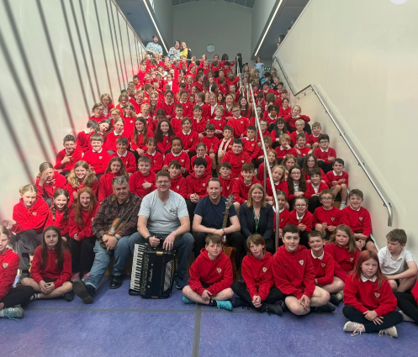
At Bun-sgoil Ghàidhlig Phort Rìgh, the school aims of Cànan (language); Càirdeas (friendship); Cultur (culture) and Coimhearsnachd (community) are helping drive progress in attainment.
Currently the school has 169 pupils and they will welcome 29 pupils into C1 in August.
The Gaelic language is at the heart of the school - pupils are fully immersed in Gaelic until they are in C4/P4 when they begin to get some English work. Very few pupils come from Gaelic speaking homes.
The school embraces every opportunity for children to take part in Gaelic speaking community activities out of the classroom.
Gaelic speakers from various professions and trades are regular visitors to the school.
A commitment to culture is deeply embedded within the school. There is singing and musical tuition, as well as regular opportunities to participate in musical performances and activities in the community.
The efforts to use music to support pupils’ health and wellbeing was honoured with the ‘We Make Music’ Gold Award earlier this session - the first school in Highland to have this accolade.
Figures presented to the education committee showed increases in the numbers of pupils exceeding their appropriate attainment levels in reading, writing and numeracy from 2024 to 2025.
Across the school, numeracy has improved two per cent each year since 2023.
Staff have committed to significant work in writing moderation, aided by school depute head teacher Shona Macdonald, who is Quality Assurance and Moderation Support officer and has led moderation sessions with other Gaelic schools.
Chair of Highland Council’s education committee John Finlayson said: “It was so encouraging to hear both these presentations and to learn of the significant efforts that their schools are making to drive through positive change and deliver improved educational outcomes for young people.
“Right across Highland, schools are employing different strategies within their own settings to improve attainment and achievement supported by the council’s Raising Attainment Strategy, Education Improvement Plan, and other collaborative approaches developed council wide or within individual Associated School Groups.”